TECHNOLOGY
Nectin-4 is a cell adhesion molecule (Nectin family member 4) expressed on a small fraction of epithelial cells and broadly across many cancer cells. It is highly overexpressed on cell surfaces across diverse cancer types — including bladder, breast, lung, and pancreatic cancers — while being largely absent from normal tissues, making it a promising target for cancer therapy.
The Science Behind Panectin®
Panectin® is a genetically engineered oncolytic measles virus that uses Nectin-4 as its functional tumor-entry receptor. Nectin-4 is highly expressed on cancer cells across multiple tumor types (bladder, breast, lung, pancreatic, etc.) while being largely absent from normal tissues — meaning Panectin cannot infect normal cells, and tumor selectivity is structurally encoded in the receptor biology. Following infection, syncytia (multinucleated giant cells) are also formed, inducing cancer cell killing, with a synergistic effect through the accompanying activation of anti-tumor immunity anticipated.
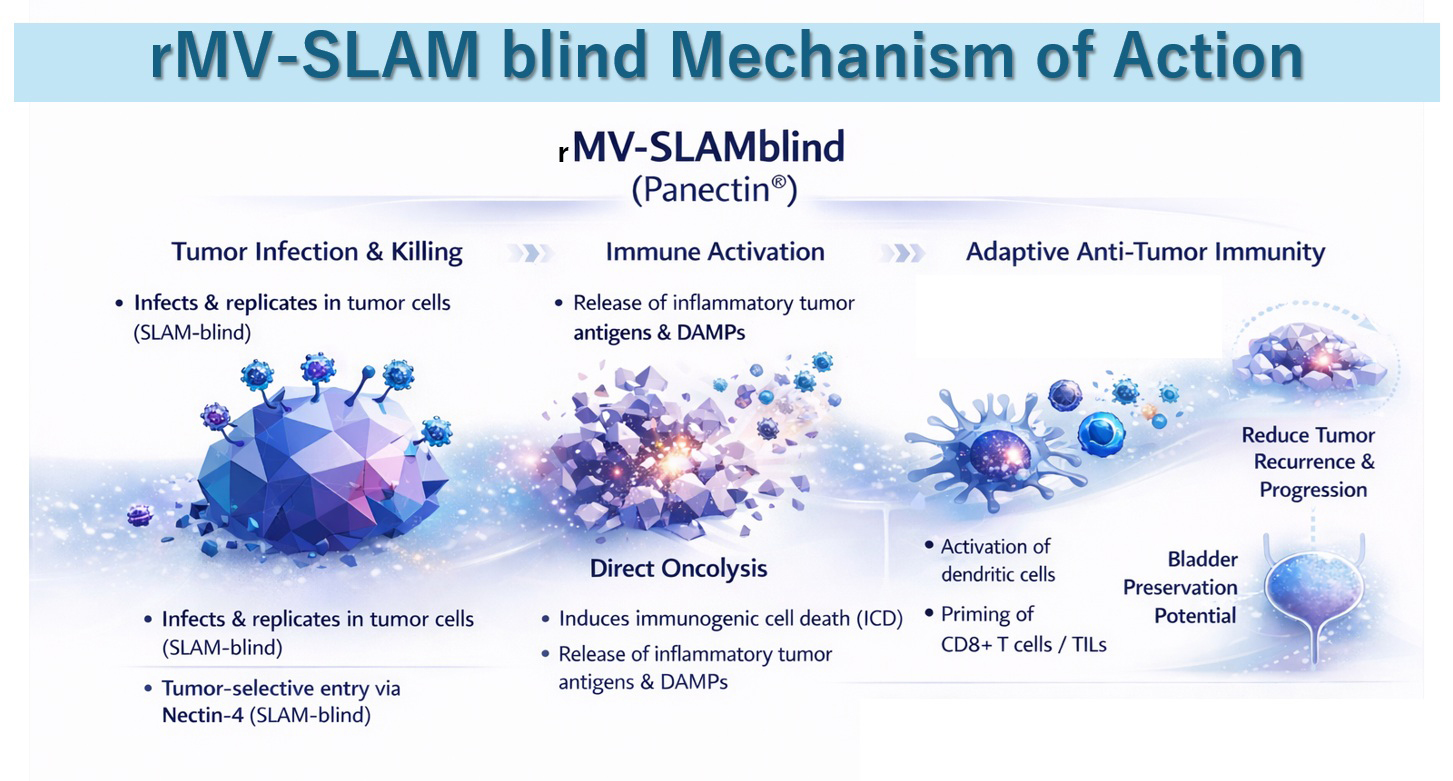
Mechanism of Action (MoA)
Nectin-4-Selective Infection
Panectin uses Nectin-4 as its sole entry receptor. Nectin-4 is highly expressed on tumor cells but largely absent from normal tissues — because normal cells do not express Nectin-4, Panectin cannot infect them. Tumor selectivity is functionally guaranteed by receptor distribution.
Intratumoral Replication → Syncytium Formation
After infecting tumor cells, Panectin induces fusion with adjacent tumor cells, forming syncytia (multinucleated giant cells). Direct tumor cell killing mediated by syncytium formation occurs across neighboring cancer cells.
Induction of Cellular Immunity
Dendritic cell activation via tumor antigens and induction of anti-tumor T cell responses occur.
Systemic Anti-Tumor Immunity (Abscopal Effect)
Dendritic cell activation and anti-tumor effects on non-injected distant lesions mediated by tumor-specific CD8+ T cells have been shown in preclinical models.
Differentiation from Existing Approaches
Nectin-4-Targeted Design
🎯Panectin uses Nectin-4 as its sole entry receptor. Nectin-4 is broadly overexpressed on tumor cells while being largely absent from normal tissues — normal cells cannot be infected, and tumor selectivity is encoded in the receptor biology.
🧬Direct Tumor Killing via Syncytium Formation
Direct killing via syncytium formation through intracellular replication and cell fusion is expected — a mechanism distinct from other OVs as suggested preclinically.
🛡️SLAM-blind Design — Immune Cell Infection Eliminated
Wild-type measles virus enters immune cells via the SLAM receptor. Panectin has been genetically engineered to completely eliminate this entry pathway. Immune cells cannot be infected by Panectin.
🔬Activation of Anti-Tumor Immunity
Tumor cell destruction releases tumor antigens and DAMPs that activate dendritic cells, triggering the potential of immunogenic cell death (ICD). Activation of systemic anti-tumor T cell responses has indeed been shown in preclinical models. Combination with PD-1/PD-L1 inhibitors is also under investigation (patent pending).